Your EQ Settings Say More About You Than Your Spotify Wrapped Ever Could
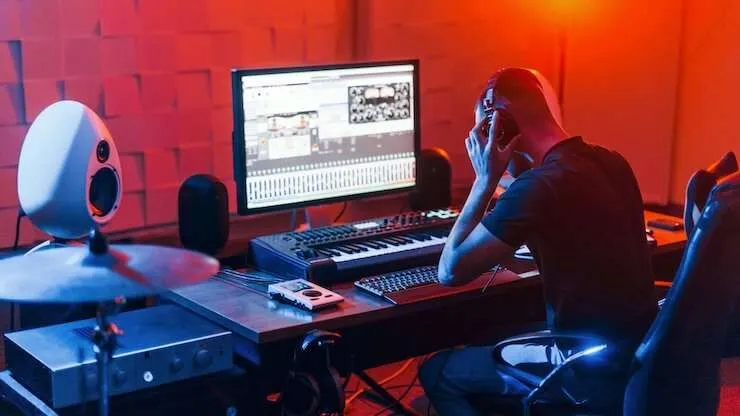
Photo: person adjusting equalizer settings headphones listening setup studio, via www.practical-music-production.com
Every December, Spotify Wrapped rolls around and the internet floods with screenshots. Top artists, top genres, total minutes listened. People share them like personality tests, like horoscopes with receipts. But here's the thing — those stats tell you what someone listened to, not how they listened to it. And increasingly, audio engineers, UX designers, and even behavioral psychologists are arguing that the "how" is where the real identity lives.
Welcome to the age of the sonic signature.
More Than a Playlist
There's a guy in Austin who has spent three years dialing in his home listening setup. He can tell you exactly why he boosted the 8kHz shelf by 2.5 dB on his parametric EQ. He'll explain the difference between how his Focal bookshelf speakers render the reverb tail on a Bill Evans recording versus his old Klipsch towers. Ask him what his favorite album is and he'll pause, genuinely unsure. Ask him about his listening chain and he'll talk for an hour.
He's not an anomaly anymore.
Across forums like Head-Fi, Reddit's r/audiophile, and Discord servers dedicated to everything from in-ear monitor tuning to room acoustics, listeners are investing serious time — and serious money — into crafting a personalized audio environment. This isn't just about gear collecting or flex culture, though that element definitely exists. It's about something more fundamental: the idea that how you shape sound is a form of self-expression as legitimate as the music you choose to play through it.
The Psychology of Sonic Preference
Researchers have known for a while that sound preference isn't random. Studies on psychoacoustics consistently show that individuals differ significantly in their sensitivity to specific frequency ranges, dynamic contrast, and even spatial imaging. Some of these differences are physiological — the shape of your ear canal literally affects what you hear. But a substantial portion is learned, shaped by environment, culture, and experience.
Dr. Daniel Levitin, neuroscientist and author of This Is Your Brain on Music, has written extensively about how our earliest sonic experiences wire our aesthetic preferences in ways that persist for life. The music your parents played, the acoustic environment of your childhood home, even the ambient sounds of the neighborhood you grew up in — all of it contributes to a kind of internal audio blueprint.
That blueprint, when externalized through gear choices and EQ decisions, becomes something remarkably personal. A listener who grew up in a loud household might gravitate toward compressed, punchy mixes. Someone who spent summers at live jazz clubs might crave open soundstages and dynamic range that breathes. Your preferences aren't arbitrary — they're autobiographical.
Audio Profiles as Digital Fingerprints
Here's where it gets really interesting for the tech side of the industry. Several audio companies are already experimenting with what you might call "sonic profiling" — using listener behavior and preference data to build individualized audio fingerprints that go far beyond genre tags.
Sony's 360 Reality Audio platform, for instance, incorporates ear shape analysis to personalize spatial audio rendering. Dirac Research develops room correction algorithms that adapt to individual hearing profiles. Audyssey, built into countless AV receivers, creates unique equalization curves based on your specific listening environment. These aren't just convenience features. They're the infrastructure for a future where your audio identity is as portable and persistent as your Netflix watch history.
Startups are already pitching the concept further. Imagine a streaming service that doesn't just recommend music based on what you've played, but on the acoustic signature of how you prefer to hear it — your preferred dynamic range, your sensitivity to high-frequency detail, your tolerance for bass weight. That's not science fiction. The data infrastructure to build it already exists.
The Culture of Active Curation
What's shifted culturally is the move away from passive consumption. For most of the streaming era, the dominant listener behavior has been lean-back: hit shuffle, let the algorithm cook, enjoy the ride. That's still the majority experience, and there's nothing wrong with it. But a growing segment of listeners — younger ones especially — are pushing back.
There's a reason "audiophile" content is exploding on TikTok and YouTube. Channels dedicated to headphone reviews, cable rolling, DAC comparisons, and tube amplifier builds are pulling in millions of views from audiences that skew surprisingly young. The gear isn't always expensive — budget audiophile culture is its own thriving scene, built around squeezing premium sound out of affordable equipment. The point isn't the price tag. The point is the intentionality.
When you spend an afternoon adjusting your EQ curve to get a specific pair of headphones to sound exactly right to your ears, you're not just optimizing hardware. You're making a statement about how you believe music should feel. That's identity work, full stop.
What It Means for Artists and Engineers
For music producers and audio engineers, this shift carries real implications. The old assumption — that a mix should sound good on everything from earbuds to car speakers to club systems — is being complicated by the reality that a growing portion of the audience is listening on highly personalized, tuned setups.
Some engineers are already thinking about this. Mixing decisions around dynamic range, stereo width, and low-frequency extension are increasingly being made with the understanding that a meaningful chunk of the audience will hear those choices through a lens of their own sonic preferences, not a neutral playback environment.
The conversation around loudness normalization on streaming platforms is partly about this tension. When Spotify or Apple Music automatically adjusts playback levels, it flattens some of the dynamic character that audiophile listeners specifically seek out. Tidal's push into lossless and hi-res audio is, in part, a product built for people whose audio identity depends on access to the full resolution of a recording.
Sound as Self
None of this means the casual listener is doing music wrong. The beauty of audio culture is that it accommodates everything from the person who just wants something playing in the background to the person who has spent years building a listening room with acoustic panels and tube gear.
But the emergence of the sonic signature — the idea that your audio preferences constitute a genuine and meaningful expression of identity — marks a real evolution in how we think about the relationship between people and sound. Your playlist tells people what you like. Your EQ curve tells them who you are.
At Sonirai, we've always believed that sound is more than content delivery. It's experience, identity, and connection. The fact that technology is finally catching up to that idea? That's a frequency worth tuning into.