Ghost Tracks: How AI Is Bringing Faded Recordings Back from the Edge of Silence
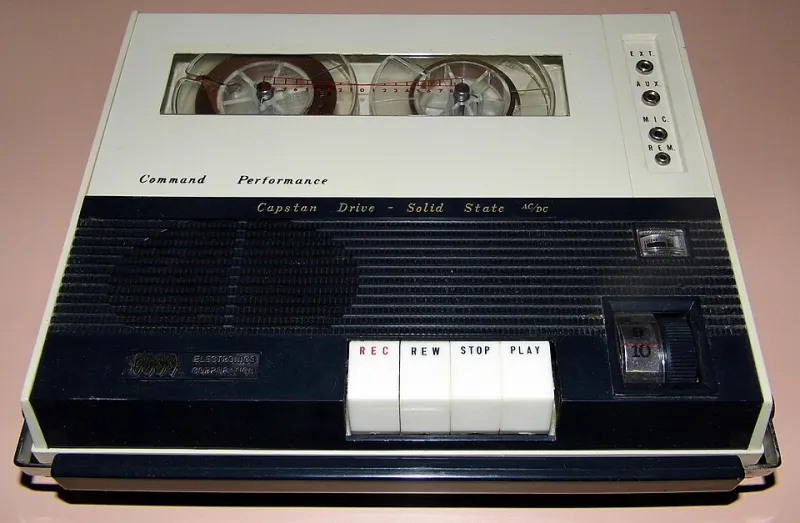
Photo: Joe Haupt from USA, CC BY-SA 2.0, via Wikimedia Commons
The tape is falling apart. Literally. A phenomenon called "sticky shed syndrome" — caused by the breakdown of magnetic tape binders over decades — has been quietly destroying irreplaceable recordings since the 1970s. Add in storage neglect, flood damage, fires, and the simple entropy of time, and the music world is sitting on a ticking archive crisis that most casual listeners have no idea exists.
But something new is happening in studios and server farms across the country. Producers, engineers, and AI researchers are combining machine learning tools with deep musicological knowledge to do what once seemed impossible: recover the unrecoverable, separate the inseparable, and in some cases, complete recordings that their creators never got to finish.
The results are extraordinary. The ethical terrain is genuinely murky. And the conversation about what counts as authentic is getting louder by the day.
The Science of Audio Resurrection
At its most basic, AI-assisted music restoration works by training models on enormous datasets of clean audio, then using those models to identify and subtract noise, fill spectral gaps, and reconstruct missing frequencies in degraded recordings.
Think of it like image upscaling, but for sound. A photograph that's been photocopied fifty times loses resolution and sharpness — but if you know what the original subject looked like, you can make educated guesses about what got lost. Audio restoration works on similar logic, with the added complexity that sound unfolds across time rather than space.
More advanced applications go further. Stem separation tools — like the open-source Demucs model developed at Meta, or commercial tools built on similar architectures — can isolate individual instruments and vocals from a fully mixed track. A recording where the vocals are buried under a collapsed mono mix can be partially reconstructed, the voice lifted out and re-balanced.
For producers working with historical material, this is transformative. "I worked on a session from the early 1960s where the original multitrack had been lost," says Chicago-based producer and archivist Dominic Farrell. "All we had was a mono acetate pressing with significant surface noise. The AI tools let us separate the vocal from the piano accompaniment well enough that we could actually hear what the singer was doing. It changed how we understood the performance entirely."
Finishing What Was Never Finished
Restoration is one thing. Completion is something else entirely — and it's where the technology starts generating real debate.
Several high-profile projects in recent years have used AI to reconstruct or complete recordings left unfinished at a musician's death, or abandoned during studio sessions that never made it to release. The process typically involves training a model on an artist's existing catalog to understand their tonal tendencies, phrasing habits, and stylistic signatures, then using that model to generate or fill in missing musical elements.
The results have ranged from genuinely moving to deeply uncomfortable, depending on who you ask. When the surviving Beatles used AI-assisted audio tools to isolate John Lennon's vocal from a demo tape for the 2023 release of "Now and Then," the reaction split along predictable lines: fans embraced it as a gift, purists questioned whether the finished product reflected Lennon's actual artistic intent.
"There's a real difference between recovering what was there and inventing what might have been," says audio engineer and ethicist Rachel Nguyen, who consults for labels on archival projects. "The first is preservation. The second is a creative decision made by people who aren't the artist. And we need to be honest about that distinction."
The Estate Problem
Who gets to decide what happens to a dead artist's unfinished work? It's a question that copyright law answers in one way — estates and label rights-holders hold the keys — and that artistic ethics answers in a more complicated way.
AI tools have lowered the barrier to this kind of work dramatically. What once required a major label budget and a team of engineers can now be approximated, at least roughly, with consumer-grade software. Independent producers are experimenting with AI-reconstructed sessions from artists whose estates have no idea the projects exist.
Some of those projects are being released quietly online. Others are circulating in collector communities. The legal exposure is significant, but enforcement is patchy, and the technology is moving faster than the law.
"The genie is out of the bottle," says Marcus Teel, a Nashville-based producer who specializes in country and Americana archival work. "You can either engage with it thoughtfully, with proper permissions and transparent methodology, or you can pretend it isn't happening and lose control of how your artists' legacies get handled. Labels that are ignoring this are going to regret it."
Preservation vs. Transformation
Not every application of this technology raises red flags. Much of the most valuable AI-assisted audio work happening right now is purely archival — recovering field recordings of traditional music made by ethnomusicologists in the mid-20th century, restoring oral history recordings from civil rights organizations, cleaning up regional radio broadcasts that document vernacular American music that was never commercially released.
For this kind of work, the ethical calculus is relatively clear. The goal is fidelity to what existed, not creation of something new. The standard is accuracy, not artistry. And the beneficiaries are historians, educators, and communities whose cultural heritage is literally disappearing on degraded media.
"We're in a race against time with some of this material," says Farrell. "Tapes that were recorded in the 1950s are hitting the end of their physical lifespan right now. If we don't digitize and restore them in the next decade, they're gone. AI tools are the only reason we're keeping up."
The Transparency Question
Perhaps the most pressing issue in this space isn't whether AI restoration should happen — it's how transparent the process should be when it does. Listeners who stream a newly released archival recording deserve to know whether they're hearing something recovered or something reconstructed. The difference matters.
A growing number of producers and labels are pushing for standardized disclosure — liner notes equivalents in the streaming era that specify which tools were used, what was restored versus generated, and who made the creative decisions. It's a reasonable ask, and the industry's response to it will say a lot about how seriously it takes the distinction between preservation and invention.
Here at Sonirai, we believe that sound carries history in a way nothing else quite does. The crackle of a 1930s blues recording isn't just noise — it's evidence of a specific moment in time, a specific room, a specific human being doing something that mattered. AI gives us the ability to hear those moments more clearly than ever before. What we owe those moments is honesty about how we got there.